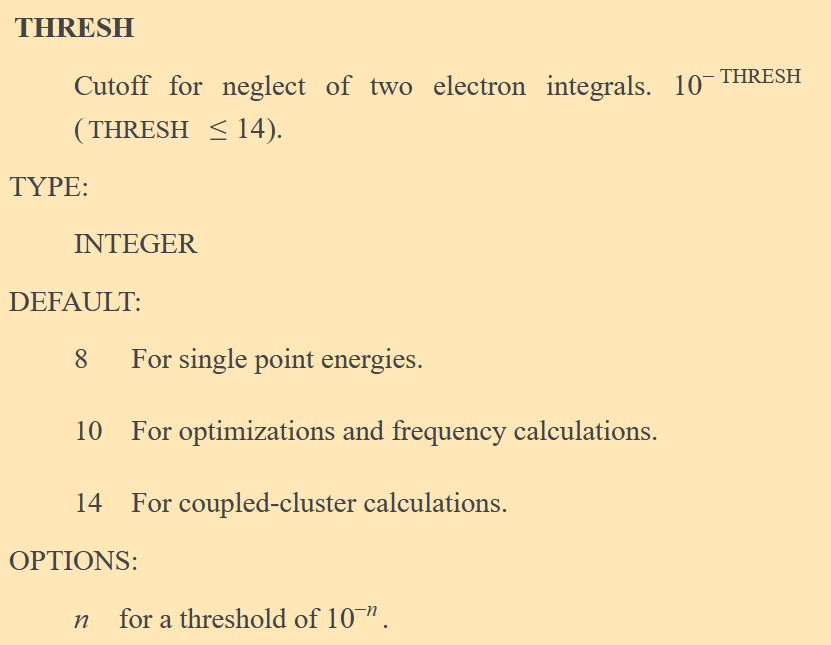
The descriptions of THRESH and S2THRESH in the current QChem manual specify settings of less than or equal to 14:
image|644x500
Do these keywords behave intuitively past 14? Not sure why this number is noted, after reading up on the forums I was considering tightening some integral thresholds to 16 after occasional SCF convergence problems with stretched bonds in CDFT (also trying other things like the ROBUST algorithm).
I would try SCF_ALGORITHM = ROBUST as a first resort (which does adjust some thresholds).
Regarding THRESH and S2THRESH, those comments in the manual may be historical (as 14 used to be a hard-coded limit). Both can be set to 16. Double precision is only about 15.5 decimal digits so it’s questionable whether 16 gets you anything extra but I’ve never had problems. Usually these are issues for large molecules / basis sets with linear dependencies, whereas bond-breaking is typically not a THRESH problem.
(I corrected this in the manual for future editions.)
1 Like
Definitely, thanks for clarifying that point! I thought it would be harmless to tighten those thresholds but it is unlikely to address the underlying problem (SCF convergence at a problematic midpoint geometry, in a batch scan of a PCET proton transfer coordinate).
It seems that only RCA, DIIS and RCA_DIIS are implemented for CDFT at this time. I am trying fragment initial guesses (aligned with the CDFT definition) to see if it stabilizes things.
I think you’re correct that it’s a limited subset of SCF algorithms for CDFT but I had thought GDM was available also, and a simple test job didn’t try to stop me from using that one.
I based that on the manual section 5.11.3 Job Control which only indicated those three for CDFT. Not sure if CDFT is supported by GEN_SCFMAN at all.
I did try ROBUST, ADIIS_DIIS and DIIS_GDM, but the log of DIIS errors produced was the same as for DIIS and convergence stalled at 10^-5. I did not explore more detailed printouts.
For clarity, here’s my input for the isolated problem geometry. I had been able to converge very similar structures by CDFT previously without much issue at ~200 cycles, but perhaps this one has a very borderline geometry.
$molecule
1 2
C    2.523658627  -3.833545588   2.677943018
H    2.387030887  -4.759711978   2.108653038
C    1.466499097  -2.941024058   3.089813868
H    0.397929477  -3.072299908   2.891973398
C    2.057103837  -1.869558018   3.821709048
H    1.525635557  -1.027212798   4.277524048
C    3.482840987  -2.097177368   3.865301038
H    4.216432007  -1.460596708   4.372945538
C    3.763275817  -3.333763068   3.195936678
H    4.747818637  -3.799431708   3.081170938
C    2.936015657  -0.051612548   1.145687098
H    2.884253157   0.886755512   1.704518088
C    4.151138617  -0.759071708   0.850891358
H    5.159157867  -0.449300038   1.137733788
C    3.803364967  -1.914906788   0.087113828
H    4.497963627  -2.661317628  -0.310858992
C    2.377668007  -1.926792738  -0.074890552
H    1.819536507  -2.685316498  -0.632287592
C    1.825570027  -0.729068458   0.513895408
C    0.432422377  -0.306682328   0.475824558
C   -0.581875253  -1.095752638  -0.117964722
H   -0.335963073  -2.079384528  -0.523902652
C   -1.890327703  -0.625499898  -0.227599112
H   -2.636744943  -1.260179558  -0.694540242
C   -2.234780573   0.655286582   0.240036228
C   -1.249987333   1.413223242   0.887012558
H   -1.467846313   2.397671982   1.301034468
C    0.050430647   0.942131962   1.001067368
H    0.790917427   1.584080772   1.491599948
Co   2.853984087  -1.951632738   1.911216128
N   -3.542756643   1.206089252  -0.029040642
C   -3.810578263   2.581844762   0.481134368
H   -3.051440083   3.261396452   0.086529948
H   -4.791884393   2.907552022   0.106113758
H   -3.812379843   2.591876222   1.584035528
C   -4.681533923   0.307223182   0.294037118
H   -4.588818713  -0.624151538  -0.267118802
H   -4.692159693   0.107905012   1.378380438
H   -5.619519533   0.793697812  -0.019304612
H   -3.518679933   1.338965198  -1.122167042
C   -0.846002513   1.496688632  -2.591419852
C   -0.773793593   2.765271432  -1.964770512
C    0.378821367   0.871789092  -2.941775462
H   -1.700349723   3.296814322  -1.786691552
H    0.373726097  -0.091611858  -3.459194092
C    0.454846357   3.360778542  -1.668692312
C    1.601189767   1.476559742  -2.663433842
H    0.491801017   4.337759442  -1.173511842
H    2.533107277   0.981655882  -2.955681612
C    1.657607967   2.704141322  -1.986709062
H    2.633734877   3.157361582  -1.764584312
C   -2.122322733   0.873965382  -2.868453662
O   -3.207029833   1.349171102  -2.376219052
C   -2.251902823  -0.341592328  -3.744850012
H   -1.865662293  -1.244707138  -3.233678292
H   -3.312868363  -0.498590338  -3.994392002
H   -1.685974823  -0.235373458  -4.688566142
$end

$rem
METHOD       TPSS
MEM_TOTAL    400000
JOBTYPE      sp
BASIS        def2-svp
XC_GRID      2	SG-2
SCF_CONVERGENCE 8
SCF_ALGORITHM RCA_DIIS
MAX_SCF_CYCLES 400
SOLVENT_METHOD   smd
DFT_D        D4
CDFT         true
CDFT_THRESH  8
NO_REORIENT  true
POINT_GROUP_SYMMETRY false
INTEGRAL_SYMMETRY    false
MOLDEN_FORMAT   TRUE
$end

$smx
solvent THF
$end

$cdft
-1.0
1 1 39
0.0
1 1 39 s
$end
SCF_ALGORITHM = GDM or DIIS_GDM does seem to work with this input, at least in Q-Chem v. 6.4. For organometallics, I would also start with a SCF_GUESS = FRAGMO and define a single-atom fragment containing the metal, so that you give it the desired charge state in the guess. You can make each separate ligand into its own fragment. Finally, I might set XC_GRID = 000099000590 to get a EML(99,590) grid, as CDFT is sometimes a bit more sensitive to the grid as compared to conventional DFT with the same functional (because the constraints are implemented via the quadrature grid).
Interesting, did it converge? I’m currently running QChem 6.3, which DOE Perlmutter just updated to.
I did try SG-3 and also saw convergence failure. Currently trying the EML(99,590) grid you recommend.
I also tried SCF_GUESS = FRAGMO, but it seems to interact badly with CDFT. The fragment child jobs try to inherit the CDFT parameters and then crash.
$molecule
1 2
--
1 1
C    2.523658627  -3.833545588   2.677943018
H    2.387030887  -4.759711978   2.108653038
C    1.466499097  -2.941024058   3.089813868
H    0.397929477  -3.072299908   2.891973398
C    2.057103837  -1.869558018   3.821709048
H    1.525635557  -1.027212798   4.277524048
C    3.482840987  -2.097177368   3.865301038
H    4.216432007  -1.460596708   4.372945538
C    3.763275817  -3.333763068   3.195936678
H    4.747818637  -3.799431708   3.081170938
C    2.936015657  -0.051612548   1.145687098
H    2.884253157   0.886755512   1.704518088
C    4.151138617  -0.759071708   0.850891358
H    5.159157867  -0.449300038   1.137733788
C    3.803364967  -1.914906788   0.087113828
H    4.497963627  -2.661317628  -0.310858992
C    2.377668007  -1.926792738  -0.074890552
H    1.819536507  -2.685316498  -0.632287592
C    1.825570027  -0.729068458   0.513895408
C    0.432422377  -0.306682328   0.475824558
C   -0.581875253  -1.095752638  -0.117964722
H   -0.335963073  -2.079384528  -0.523902652
C   -1.890327703  -0.625499898  -0.227599112
H   -2.636744943  -1.260179558  -0.694540242
C   -2.234780573   0.655286582   0.240036228
C   -1.249987333   1.413223242   0.887012558
H   -1.467846313   2.397671982   1.301034468
C    0.050430647   0.942131962   1.001067368
H    0.790917427   1.584080772   1.491599948
Co   2.853984087  -1.951632738   1.911216128
N   -3.542756643   1.206089252  -0.029040642
C   -3.810578263   2.581844762   0.481134368
H   -3.051440083   3.261396452   0.086529948
H   -4.791884393   2.907552022   0.106113758
H   -3.812379843   2.591876222   1.584035528
C   -4.681533923   0.307223182   0.294037118
H   -4.588818713  -0.624151538  -0.267118802
H   -4.692159693   0.107905012   1.378380438
H   -5.619519533   0.793697812  -0.019304612
--
0 2
H   -3.518679933   1.338965198  -1.122167042
C   -0.846002513   1.496688632  -2.591419852
C   -0.773793593   2.765271432  -1.964770512
C    0.378821367   0.871789092  -2.941775462
H   -1.700349723   3.296814322  -1.786691552
H    0.373726097  -0.091611858  -3.459194092
C    0.454846357   3.360778542  -1.668692312
C    1.601189767   1.476559742  -2.663433842
H    0.491801017   4.337759442  -1.173511842
H    2.533107277   0.981655882  -2.955681612
C    1.657607967   2.704141322  -1.986709062
H    2.633734877   3.157361582  -1.764584312
C   -2.122322733   0.873965382  -2.868453662
O   -3.207029833   1.349171102  -2.376219052
C   -2.251902823  -0.341592328  -3.744850012
H   -1.865662293  -1.244707138  -3.233678292
H   -3.312868363  -0.498590338  -3.994392002
H   -1.685974823  -0.235373458  -4.688566142
$end

$rem
METHOD       TPSS
MEM_TOTAL    400000
JOBTYPE      sp
BASIS        def2-svp
XC_GRID      2	SG-2
SCF_CONVERGENCE 8
SCF_GUESS FRAGMO
SCF_PRINT_FRGM TRUE
MAX_SCF_CYCLES 400
SOLVENT_METHOD   smd
DFT_D        D4
CDFT         true
CDFT_THRESH  8
NO_REORIENT  true
POINT_GROUP_SYMMETRY false
INTEGRAL_SYMMETRY    false
MOLDEN_FORMAT   TRUE
$end

$smx
solvent THF
$end

$cdft
-1.0
1 1 39
0.0
1 1 39 s
$end
with the following message:
Symmetry turned off for PCM/SM12/SMD calculation

 Q-Chem fatal error occurred in module qparser/read_cdft.C, line 43:

 Could not find $cdft section in read_cdft


 Please submit a crash report at q-chem.com/reporter


 Q-Chem fatal error occurred in module gesman/frgmchild.C, line 693:

 Error executing Q-Chem for fragment 1
I did not run it to convergence but nothing has changed with CDFT in several releases so this should be available to you also. If CDFT won’t cooperate with FRAGMO, then you could run the latter as a first job (normal DFT, to obtain converged orbitals for the redox state of interest) then read those in for subsequent CDFT job.
1 Like
Thanks for the detailed advice, it is helping a lot as I try to work through this. I did try the DIIS_GDM option and never saw the switchover to GDM at the expected threshold (10^-2).
Today I was able to converge the SCF at this geometry in one of two ways with DIIS:
- FBH partitioning, leading to a similar energy and extent of spin contamination (S2 ~ 0.9) as the nearby geometries. Previously, I had issues combining FBH and geometry optimization, but it doesn’t seem to be a problem here. Maybe the issue was motion vs. the reference fragment calculations.
- spin-only constraint on the organometallic fragment, leading to a substantially lower energy solution with less spin contamination (S2 ~ 0.75).
For consistency, I will probably pick FBH to preserve continuity with successful scans at different donor-acceptor distances.